Showing posts with label fg. Show all posts

Wednesday, May 2, 2012

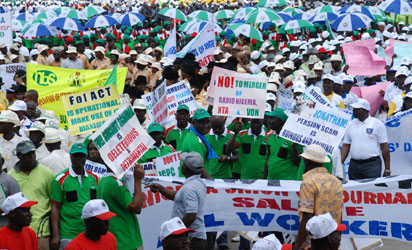
NIGERIA MAY DAY: Fashola said " I’ll no longer pay any wage imposed by FG"

Governor Babatude Fashola of Lagos, yesterday, told Lagos workers that henceforth his government would no longer pay any wage imposed by the Federal Government unless the state was part of the negotiation that brought about the wage.
Foshola who spoke while addressing workers of the state during yesterday’s May Day celebration, said the government could only pay such wage if the Federal Government made money available.
This came as organised labour in the state blamed the growing insecurity in the country to unemployment, frustration, inequalities, injustice among others.

Saturday, April 28, 2012

Ikeja bomb blast victims’ families call for assistance

The families of January 27, 2002 Ikeja bomb blast victims have called on the Federal Government  to fulfill the promise it made to them.  The Federal Government had promised to compensate the families and assist the victims children.
Speaking at a press briefing, the coordinator of the families, Mr Olaniran Majekodunmi, said  lack of response by the Federal Government  prompted them to consult their lawyer, Mr Femi Falana, who, in turn, wrote the Ministry of Defence and copied  relevant government agencies and has also written  reminders, but the initiative did  not yielded positive answer. According to him, they were asking for justice for the spilled blood of their relations at Oke- Afa  and other places in Lagos.

Monday, April 23, 2012

Nigeria: FG only implemented 10% of agreement said ASUU

The Academic Staff Union of Universities, ASUU, yesterday, said the Federal Government had only implemented 10 per cent of the agreement the parties entered into in 2009, even as it lamented that there was no law yet on the 70 years retirement age for university professors.
Speaking after a meeting of ASUU’s executive at Ekiti State University,  Ado-Ekiti,  President,  ASUU,Profesor Ukachukwu Awuzie,  said: “We are now almost at the end of the three year lifespan of the agreement and less than 10 per cent of the agreement has been implemented.
Some of the outstanding areas not implemented, according to him, include funding requirement for revitalising the nation’s university system, provision for progressive increase of annual budgetary allocation to education to 26 per cent between 2009 and 2020.
Awuzie declared that ASUU members would not subscribe to the implementation and running of the Integrated Payroll and Personnel Information (IPPS), as required by the Federal Government, saying “the union has directed that none of its members should subscribe to IPPS. It is the opinion of this union that Nigerian workers that are being forced to this scheme have a right to choose if they wish to be  guinea pigs in this experiment.”

Nigeria: Cement manufacturers seek import ban before FG’s August deadline


Cement manufacturers in Nigeria have called on the  Federal Government to ban the importation of bulk cement before the August deadline set by government, claiming that the volume of cement currently produced in the country  is enough to meet local demand.
“Government should enforce the ban before the August deadline”,  said Mr. Daljeet Ghai,  Group Chief Executive, Dangote Cement. “Dangote alone has the capacity needed to meet local demand and sustain supply of the commodity across the nation”, he said.
Group Chairman/CEO, Lafarge, Bruno Lafont also said that with the new plant commissioned by the company, the country is now self sufficient in cement.
The current production data from  the various plants in the country, obtained from Cement Manufacturers Association of Nigeria, CMAN, show that the country’s total cement production capacity is now  at 22.5 million metric tonnes (mmt) per annum while the country’s cement consumption is 18.5mmt.
Dangote alone currently accounts for 15 million mmt annum (Ibese- 6mmt, Benue Cement- 4mmt; Obajana- 5mmt) while Lafarge Wapco Cement Plc group is contributing 7.5mmt (Ewekoro l- (1.2mmt; Shagamu Cement Plant- 800,000metric tonnes and Ewekoro ll- 2.5mmt). Unicem produces 2.5mmt while  Ava cement produces 500,000 metric tonnes.
Citing the example of the company’s Ibese cement plant as basis for  confidence in the ability of  local manufacturers to meet domestic demand and still be able to export,  Dangote’s Ghai   said, “Ibese plant is grinding 480,000 tonnes per month, while daily production is 16,000 metric tonnes at  2,400 metric tonnes per hour.
“The Ibese plant, started with a daily production of 12,000 metric tonnes in February, but barely two months after, production  moved up to 16,000mmt, which is  it’s full installed capacity, and this  would lead to the achievement of the yearly target of six million metric tonnes of cement.”
Vijay Khana, Deputy Director, Operations, Ibese Cement plant added that on a daily basis, the company supplies   the market with more than 200,000 bags of cement from the plant.   ” We load 250 trucks daily; a private truck can carry 600 bags, each Dangote truck carries 800 bags; while smaller trucks carry 300 bags.”
Similarly, Nigeria’s second largest cement producer, Lafarge Cement Wapco Nigeria Plc, said they are ready for the import ban.  “For sure, I see it (ban on cement import) happening. The best thing for Nigeria is for us to manufacture here; if we manufacture here, we create jobs here, and we save the economy in terms of foreign exchange,” said Lanre Opakunle, Plant Manager, Ewekoro Cement Plant II.
Read More...

Nigeria: We’ve no powers to stop crime in N-Delta – Amnesty Office

Presidential Amnesty Office, said, weekend, that it had neither the powers nor competences to stop the crime being committed in the Niger Delta or stop any person who willfully decides to commit crime in the region.
Chairman of the Amnesty Office and Special Adviser to the President on Niger Delta Matters, Mr. Kingsley Kuku, who spoke on the development, weekend, said the office had no guns nor ammunition to  physically combat willful crime perpetrators or criminality in the region.
He spoke against the backdrop of growing attacks on the office over the occasional security breaches in the region.
Kuku said it was the responsibility of security agencies, including the police, State Security Services, SSS, and Joint Task Force on the Niger Delta to maintain security in the region.
He said:  “The very critical role of enforcing laws and dealing with criminals in Niger Delta and other parts of the country is constitutionally vested on the Nigeria Police, the SSS and of course the Armed Forces as currently represented in the states in the Niger Delta by the Joint Military Task Force.
“Amnesty Office is not a security agency and the mandate of the Presidential Amnesty Programme does not include curbing crime or enforcing laws in the Niger Delta.
“It is true that the Presidential Amnesty Programme has aided the stabilisation of security in the Niger Delta by successfully overseeing the disarmament, demobilisation and currently reintegrating the 26,358 Niger Delta ex-agitators, who accepted the amnesty and enlisted in the programme, which is in two phases.”
He expressed confidence in the ability of officers and men of JTF to protect vital oil and gas installations in the Niger Delta and deal with person or persons who attack oil facilities or generally attempt to breach the peace in the region.
Kuku said: “For emphasis, it must be clarified for the umpteenth time that pursuant to its mandate, the Amnesty Office, aided by gallant officers and men of our Armed forces pursued a very successful disarmament campaign and huge cache of arms and ammunition were submitted by the ex-agitators, prior to their being admitted into the post-amnesty Programme.
“Disarmament was concluded in December 2009 but the arms and ammunitions collected were stored at the 82 Division of the Nigerian Army in Enugu and in compliance with extant DDR codes as spelt out by the United Nations, these arms and ammunition were on May 25, 2011, completely destroyed by the Nigerian Army in Lokpanta, a boundary town in Enugu State, under the watch of the Amnesty Office.”
….As N-Delta group flays critics of amnesty programme
By Samuel Oyadongha
Yenagoa—A Niger Delta-based socio-political organisation, the Niger Delta Buckingham Palace, yesterday, flayed critics of the Presidential Amnesty Programme for ex-militants in the Niger Delta, describing them as saboteurs and enemies of development in the region.
Specifically, the group slammed those it said were hiding under the revenue sharing controversy to destabilise the region and the country. It called on other interventionist agencies and the state governments in the region to complement the efforts of the amnesty office by creating youth engagement programmes.
President of the group, Mr. Bekes ApeAre, in a statement in Yenagoa, Bayelsa State, said instead of commending the amnesty programme for bringing relative peace to the region, the critics were using other unresolved problems in the region to attack the Coordinator of the Programme and Presidential Adviser on Niger Delta Affairs, Mr. Kingsley Kuku.
The group noted that though the core mandate of the amnesty office was disarming, rehabilitating and reintegrating 26,358 ex-agitators from the region, who accepted amnesty offered them by the Federal Government, “the latter not only completed the demobilisation, disarmament and rehabilitation aspect of its mandate but it was rated globally as the best among countries, where such strategy was used to fight militancy.
“The amnesty office had so far conducted the integration phase of the programme successfully and this had led to the relative peace in the region, which led to an increase in Nigeria’s oil production from less than one million barrels per day pre-amnesty period to an average of 2.6million barrels today due to improvement in the post-amnesty programme.”

Nigeria: FG orders 24-hour ports operations

Concerned by the increasing cost of doing business in Nigeria, President Goodluck Jonathan has ordered 24 hours operations at the Nigerian ports in a bid to reduce the number of days for clearing goods as well as make the ports more competitive.
The Coordinating Minister for the Economy and Minister of Finance, Dr. Ngozi Okonjo-Iweala, dropped the hint, yesterday, in Washington at the just concluded Spring meeting of the IMF/World Bank
The minster, who addressed the Nigerian press alongside the Central Bank of Nigeria (CBN) Governor, Mallam Sanusi Lamido Sanusi; the Governor of Anambra State, Peter Obi and Dr. Mansur Murthar, Executive Director, World Bank, also said her bid for the President of the World Bank was well received by the international community and has boosted the profile of not just Nigeria but Africa as a whole.
Lamenting that Nigeria is the only country whose ports do not operate 24 hours, the Finance Minister said the country was losing out in terms of revenue as goods were being shipped to neighbouring countries that are very efficient in the management of their ports.
She said: “We are the only port working from 9.am to 5 p.m. in the world. Other ports operate 24 hours and that is why their ports are cheap because importers do not have to pay for demurrage. Apart from reducing the number of agencies in the port, which we have done, we also need to remove the bureaucratic requirements.
Noting that 60 per cent of goods shipped into West Africa are meant for Nigeria, he said it was cheaper to ship goods to Ghana than Nigeria.
The minister said the Nigeria delegation to the Spring meeting was besieged by delegates from Africa and other emerging markets with congratulatory messages, saying her bid for the position of World Bank has altered the way the multilateral institution was dealing with the developing countries.
She said her participation had boosted Nigeria’s image and had been very beneficial to the country since the Nigeria delegation arrived Washington.
On what Nigeria stands to benefit from the Spring meeting, the minister said  the Nigerian team came to the meeting to rob minds with others, to share idea and knowledge of what is happening at the global economy to help in planning and preparing for what others are forecasting about the global economy.
She said:  “It is vital for us, Nigeria does not exist in isolation. About 60 per cent of Nigeria export goes to Europe and America. So we need to hear what is happening in other economies to be able to calibrate how we might be imparted.
“What we are taking away from this meeting is that there is fragile recovery of the  US economy,  though the recovery is fragile, unemployment is still high above eight per cent, the Euro zone is even being more fragile, the sovereign debt crisis is still overhanging.”
In addition, Spain is now joining the whole configuration of countries that are having problem with sovereign debts. As you know things are very tough in Spain, unemployment is about 23 per cent and youth unemployment is 50 per cent, so one of the big economies in Europe is having problem in addition to Greece,Island and Portugal.
“So when you hear that that the global economy is fragile, US is recovering but still very difficult,  that gives you information with which to calibrate what you need to do,” she said.
The minster stressed the need for Nigeria to continue the diversification of the economy; the structural reforms on power; the ports reforms; development of sources of growth in agriculture, housing as well as improving our exports of other products.
“We do not need to depend on oil only, which is sent to these economies. We need to diversify trade to Africa countries; to growing economies like India, China and Brazil and other emerging markets. These are the key message. It just reinforces the part we are already on,” she said.
Sanusi reiterated the need for structural reforms to be put in place.
“We need to protect ourselves and hedge because of the vulnerability of our economy because of oil price. This reinforces the need to save at the time when oil prices are high because if these dark clouds translate to fall in oil prices Nigeria is going to have major problems.
“The whole idea of saying let us look at the excess crude account, let us save now when prices are over $100, is basically not because we have a problem now. But if something happens  and something may happened based on what we beginning to see, we are going to have problems in both the fiscal and the exchange rate sides.
“We have seen oil fall to $37 per barrel and we all know what the country went through. We will continue engaging until all the tiers of government agree that we have to safe,” he said.

Thursday, April 19, 2012

Nigeria: More Federal Agencies Should Go

Sentiments will overtake reasons on decisions about which federal agencies will be spared in government’s bid to cut rising cost of its operations. People are more interested in which agencies remain, rather than the rationale for the exercise.
Lobbyists are awake. Agencies will survive not based on their contributions, but on their ability to convince decision makers of their importance. From the debates on the matter, it is obvious that agencies would be saved more for their significance in funnelling patronage into the political system than service to Nigerians.
The tilts of the concerns are showing. While many appear worried about the Economic and Financial Crimes Commission, EFCC, Independent Corrupt Practices and other offences Commission, ICPC, and Federal Road Safety Corps, FRSC, they are just three of 378 agencies recommended for scrapping or merger with others to prune them from 541 to 163.
Politics, more than service to ordinary Nigerians would decide which agencies remain. Suggestions about cutting the cost of governing Nigeria have been ignored because every government understands these agencies are platforms for funnelling patronage to political protégés who serve on their boards.
Laws the National Assembly make also create more agencies. If the matter is not tackled at both ends, newer and more useless agencies would soon take the place of those that are scrapped.
Every agency comes with a full load of bureaucracy, board and staff who have to be paid, its facilities maintained and its high ranking officials would be entitled to perks like trips abroad for medical needs and shopping.
Multiplication of these wastes across 541 agencies reduces annual budgets to serving the recurrent needs of government. It is the reason that for years, capital expenditure has been a minuscule part of the budget. Savings from pruning agencies would boost capital expenditure which will create more jobs.
Our unwieldy federal structure encourages wastes. A federal university in 36 States instantly translates to 36 federal university councils. When each State gets a federal medical centre, 36 boards to run the centres are created. These two decisions result in 72 agencies. Constitutional amendments that cede more powers to the States can tackle this aspect more sustainably.
Government requires a lot of political will  to act on this report. Though it dealt with agencies, government should also tackle the number of political appointees – Ministers and Special Advisers. It is understandable if the President appoints 36 Ministers to meet a constitutional requirement, but it is imprudent to exceed that number and top it with a horde of aides.
The President said he will prune agencies in two months – that is in June. We will hold him by his promise.

Senate to FG: Use military might to crush terrorism

The Senate, yesterday, urged the Federal Government to invoke its military might and all instruments of national power at its disposal to put an end to the high level of terrorism in the country following incessant attacks by members of the Boko Haram sect.
Condemning the activities of the Boko Haram in some parts of the north in recent times, the Senate also warned that the move had become imperative if disintegration of the country must be averted against the backdrop that the unity and sovereignty of Nigeria was being threatened.
It said the government must act fast, recognising the fact that terrorists had declared war on Nigeria.
These were some of the resolutions reached at the end of discussions on a motion entitled: ‘’Terrorist Attack on Kaduna on 8th April, 2012 by Senator Mohammed Sani Saleh, Kaduna Central and 10 other Senators. Others who moved the motion were Senators Abu Ibrahim, Adamu Gumba; Mohammed Magoro; Mohammed Bindo; Ahmed M. Makarfi; Ibrahim Musa; Mudashiru Hussain; Nenadi Esther Usman; Olugbenga Obadara and Yusuf Musa Nagogo.
While calling on its Committee on National Security, Intelligence, Defence and Army and Police Affairs to intensify their oversight functions over the security agencies with a view to improving their capabilities in handling the current security challenges facing the country, they, however, stressed the need for a supplementary budget by the executive to handle the security problem, adding that there was the need to engage the northern governors at least to know their own perspective, find out all the measures that are in place and how far they have worked.
The Senate also called on the Federal Government to pay adequate compensation to victims of Kaduna city bomb explosion and the bereaved as well as those who suffered same fate in other places.
The Senators observed a minute silence in honour of those who lost their lives in the Kaduna bomb explosion and other attacks across the country.
Ekweremadu averts a rowdy session
During debate on the motion, a rowdy session was averted by the Deputy Senate President, Ike Ekweremadu, when tempers became high when there were reactions to a question by Senator Olubunmi Adetunmbi, ACN, Ekiti North whether there was government in Nigeria, even as he was stopped through a point of order by Senator Smart Adeyemi, PDP, Kogi West, adding that it was wrong for Senator Adetunmbi to have asked such a question when a government is in place. Senator Ekweremadu saved the situation when it was almost degenerating into rancour.
In his remarks, Ekweremadu, who presided, however, expressed the need for a lasting solution to the issue of terrorism in the country, adding that since the issue borders on security of life and property, necessary actions must be taken to save the country from turning into anarchy.
According to him, “these are moments when we need to act as a Senate, act as patriotic citizens of this nation, and I am happy that we did that. The issue of security borders on the existence of this country and if this country did not exist, then there will be no Senate, House of Representatives and there will be no governor.
“This is a matter of top priority for every one of us. If we did not deal with this matter, we may be heading to anarchy and nobody wants that because nobody knows where it will end. We never believe when we had democracy in 1999 that we will get to a situation where roads will be blocked, there will be state of emergency in some places, and those who have opportunities to earn a living cannot even do that. I believe that democracy comes with freedom but if that freedom is being curtailed by the happenings of the day, then something is wrong and we need to do something about it.
Senators react
Prior to remarks by Ekweremadu, Senators raised their views on the issue of terrorism in the country. At the prolonged debate, while some Senators accused the Federal Government and security agents of not taking appropriate measures to address it, others believed efforts were being made to curtail the activities of the terrorists and the need to intensify efforts.
Making his contributions, Senator Olubunmi Adetunmbi, who asked where the power of the Senate lies, said: ‘’Where is the power of the Senate to make things happen, to respond to the yearnings of Nigerians that these killings are too much and are coming too often. Nigerians are tired of the condemnation of the bombings, tired of one minute of silence; they don’t want these loved ones to be lost.
Also in his contributions, Chairman, Senate Committee on Media and Public Affairs, Senator Enyinnaya Abaribe, PDP, Abia Central said: “We are at war and when at war, you do the needful. We are at war against those who want to break up this country. I don’t believe this security challenge will break up Nigeria; what will break up Nigeria is knowing what to do and refuse to do it. Security agents need to step up. They have the duty to protect themselves and then, the citizens.
For Senator Gbenga Ashafa, ACN, Lagos East: “This is a war waged against Nigeria and if we are not careful, can consume all of us. Solutions: National identification programme must be a top agenda of the Federal Government.”
In his contribution, Senator Mohammed Magoro, PDP, Kebbi said: “I will tell Nigerians that the security agents are doing their best. We must make provision for modern technology but I will say, so far, so good.
For Senator Chris Anyanwu, APGA, Imo, “the resultant effect is that children would lose value for life. In the light of extreme nature of this, I want to suggest that culprits should face extreme measures. Traditional rulers should be held responsible for conspiracy of silence. There should be national emergency law for such situation.”
Wednesday, April 18, 2012

FG declares 12-month gas supply emergency plan

The Federal Government, yesterday, declared a ‘12-month  gas supply emergency plan’  designed to correct the mis-alignment  and other challenges in the nation’s gas to power aspirations.
Minister of Petroleum Resources, Mrs. Diezani Alison-Madueke pointed out in a statement in Abuja that a key aspect of the transformation agenda of President Goodluck Jonathan was the accelerated and sustained delivery of the much needed energy services to the Nigerian people, in particular, electricity.
According to her, the delivery of gas to assure sufficient, uninterrupted supply to existing, as well as new thermal generating plants have been special focus area of mine and the Ministry of Petroleum Resources.
“Up to recent times, gas supply to power plants outstripped demand to the extent that significant volumes of available gas remained unutilised on a daily basis.
“However, a close analysis of the supply chain has revealed that over the last 10 years or so, there has been significant misalignment between power projects and gas supply sources.”

Tuesday, April 17, 2012

Airfare disparity: Revive dead Nigeria Airways now, Senate tells FG

THE Senate, yesterday, told the Federal Government to revive the dead Nigeria Airways before the end of this administration if the present indiscriminate hike in airfares by foreign airlines must be addressed.
It also called for a review of the Bilateral Air Services Agreement, BASA, between Nigeria and Britain.
This came as management of British Airways told the senators that rather than discuss the issue of fare disparity, Nigeria should open up the skies and let more airlines come in, explaining why it could not cut down fares.
According to the Senate, the aviation authority should restore the agreement which allows Nigeria and Britain equal slots and frequency of 21, which only the British airline enjoys the full privilege, while Nigeria’s Arik Air was left with only seven.
Speaking, yesterday, at the opening of a three-day public hearing on the violation of aviation laws and practice by foreign airlines in Nigeria and lapses in operation of the regulatory agencies by the Senate Committee on Aviation, Senate President, David Mark, said the return of the nation’s national carrier would create employment opportunities for Nigerians as well as restore the country’s image in the global aviation industry.
Mark, who was represented by the Deputy Senate President, Ike Ekweremadu, challenged Nigeria to use the present scenario in the aviation sector to make its impact felt in Africa.
He said:  “It is important that we direct the Minister of Aviation before the end of this tenure that Nigeria Airways is brought back on stream. I do hope that they will accept the challenge.
“We feel very embarrassed each time we travel abroad and see other airlines carry the national flag of their countries and the names of their respective countries and Nigeria is missing. It is not only for the purpose of national pride, it’s important for the development of our tourism. It will also generate income and create employment for our people. This is the time for us to do something about it and restore Nigeria’s past glory in respect of aviation and air travels. ‘’
Ashiru blames lapses on FAAN, NCAA, others
Minister of Foreign Affairs, Ambassador Olugbenga Ashiru, told the committee that the lapses in the aviation industry should be blamed on the Federal Aviation Authority of Nigeria, FAAN, Nigeria Civil Aviation Authority, NCAA, and other agencies, and warned against allowing what he  described as commercial dispute degenerate into diplomatic row.
He said: “It should be a commercial discussion and not dispute. What we have is a commercial dispute and what we see happening now is a failure of regulatory agencies to do their jobs. If the regulatory agencies had done their job very well, we would not have got to this stage. There is no justification for the rip off that Nigerians are going through.”